Granite Buyers Are a Deliberate Group
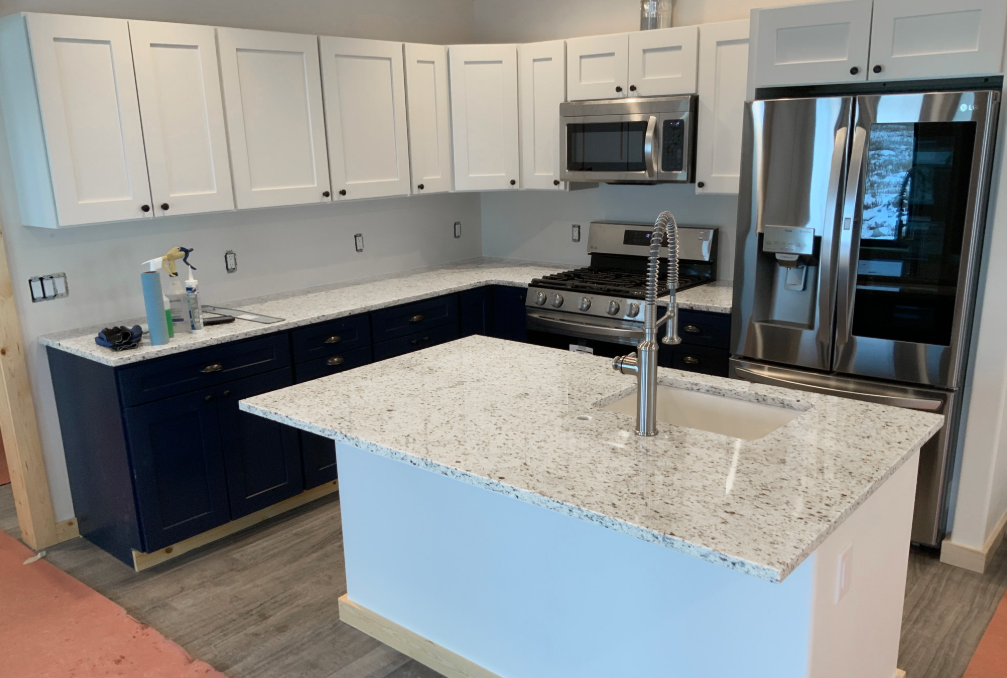
The 2025 U.S. Houzz Kitchen Trends Study found that 19 percent of renovating homeowners chose granite, with engineered quartz leading at 39 percent and quartzite at 11 percent. The people still choosing natural granite tend to be choosing a specific slab, and a specific slab has opinions about its edge.
That is the part most edge-profile articles skip. The picture in the showroom binder is not a menu. It is a list of possibilities that gets shorter the moment we know your material.
Thickness Sets the Menu
Most granite and quartz reaches us in one of two thicknesses: 2cm, roughly three quarters of an inch, and 3cm, roughly an inch and a quarter. Porcelain and ultra-compact materials can run as thin as 12mm. That single number rules profiles in or out before anyone opens a sample book, as we cover in our countertop FAQ.
A 3cm slab has enough material to carry a deep, sculpted profile cut from solid stone. A 2cm slab does not. There is simply not enough depth for the shape to develop.
Pro Tip: A 2cm slab can still read as thick. We laminate or miter a buildup strip onto the front. Just know that a laminated buildup leaves a glue line about an inch down from the top surface. On a quiet, uniform granite it disappears. On a dark granite with strong movement, that line reads as a break in the pattern, because the strip is a different piece of the slab than the top.
Your Stone’s Grain Narrows the List Again
Granite is crystalline, not uniform. Some granites are fine and tightly knit. Others are coarse, with large feldspar and quartz crystals you can pick out from across the room. Tooling treats those two stones very differently.
Pro Tip: On a coarse-grained granite, ask for an eased or demi-bullnose rather than an elaborate multi-step profile. Fine detail cut across large crystals tends to chip at the grain boundaries, sometimes during polishing and sometimes on the truck. The same shop and the same tooling will give you a crisp result on a dense, fine-grained stone. Different stone, different answer.
A chiseled edge, also called a broken edge, follows the same logic in reverse. It relies on the stone fracturing along its own natural line, so it is wonderful on a granite with character and underwhelming on a flat, uniform one.
Mitered Edges and Slab Math
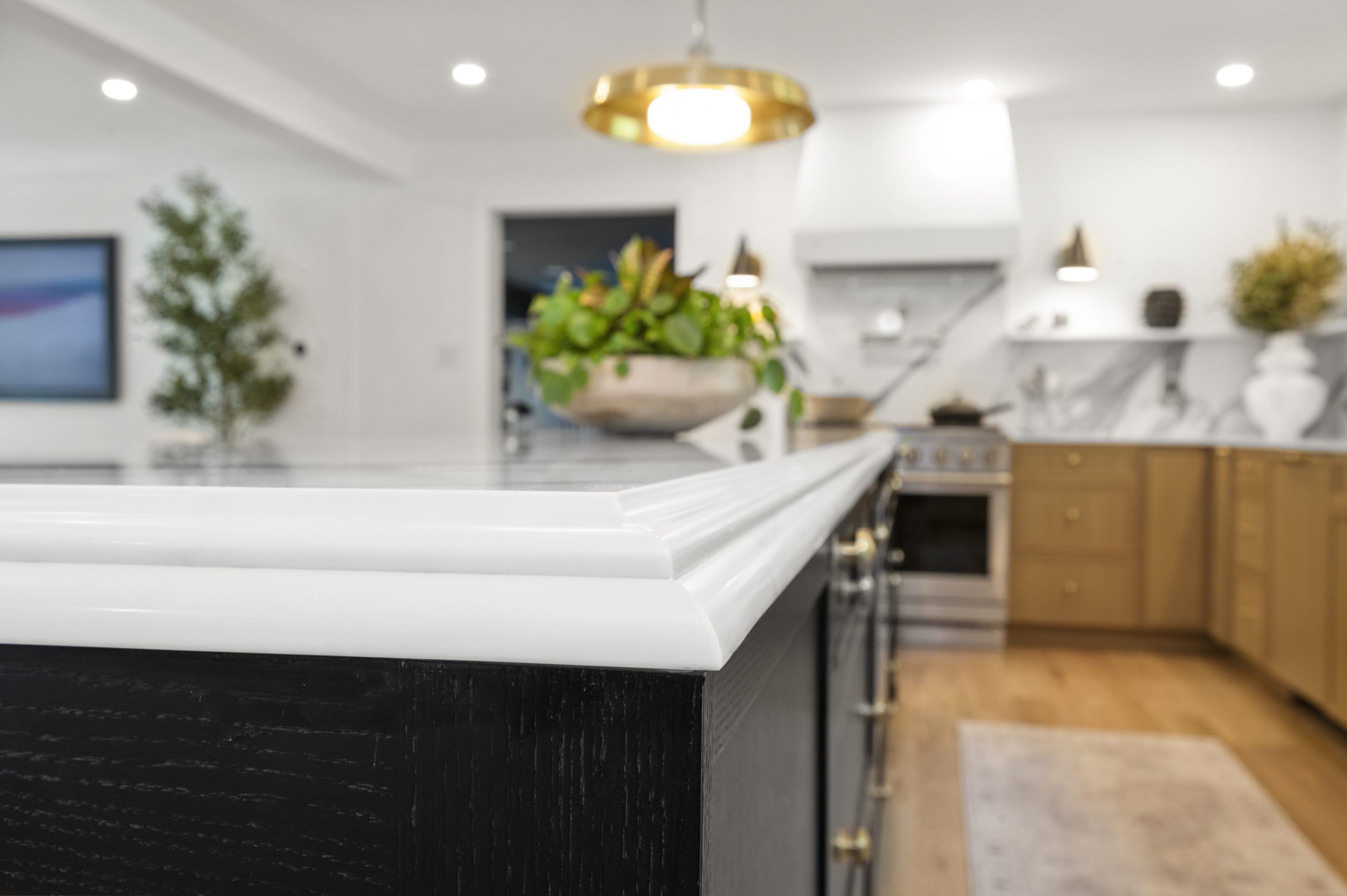
A mitered edge is how you get a thick, monolithic waterfall look without a visible laminate seam. Two pieces meet at a 45-degree joint at the top corner, so the polished top runs unbroken over the edge.
Pro Tip: Choose a mitered edge before slab layout, never after. A four inch mitered apron consumes roughly four extra inches of slab for every running foot of countertop. On a large Montana kitchen, that math can turn a two-slab job into a three-slab job. We also cut the apron from the strip of slab directly adjacent to the top so the veining wraps the corner instead of stopping dead at the miter. That is a layout decision made at the saw, and it cannot be recovered later.
Still deciding on the best edge for granite countertops before you have picked out your slab?
Bring the question to us first. Request a free countertop estimate or call us at (406) 586-7160, and we will tell you which profiles your stone can actually hold.
Match the Edge to How You Actually Live
Eased, sometimes called straight or pencil, is our workhorse for a reason. It is clean, it suits almost any material, and it sheds crumbs. A demi-bullnose is kinder on forearms and hips at a seated bar or an island where kids do homework. A crescent adds a soft shadow line without the fuss of a deep profile.
Deeper profiles collect more, and any edge with a recess needs a little more attention during cleaning. Our care and maintenance guide covers what keeps a polished granite edge looking new.
Let Us Get Your Edge Right the First Time
With over 40 years of combined experience and more than 10,000 countertop installations, we have seen which edges hold up in Montana kitchens and which ones look great for a season. We will sit down with you, look at your actual slab, and tell you honestly what it will carry. You can see how that works on our countertop installation process page.
Visit us in Bozeman or Helena, or call (406) 586-7160 to start your project. Do it right the first time, on time.
Sources: 2025 U.S. Houzz Kitchen Trends Study.